







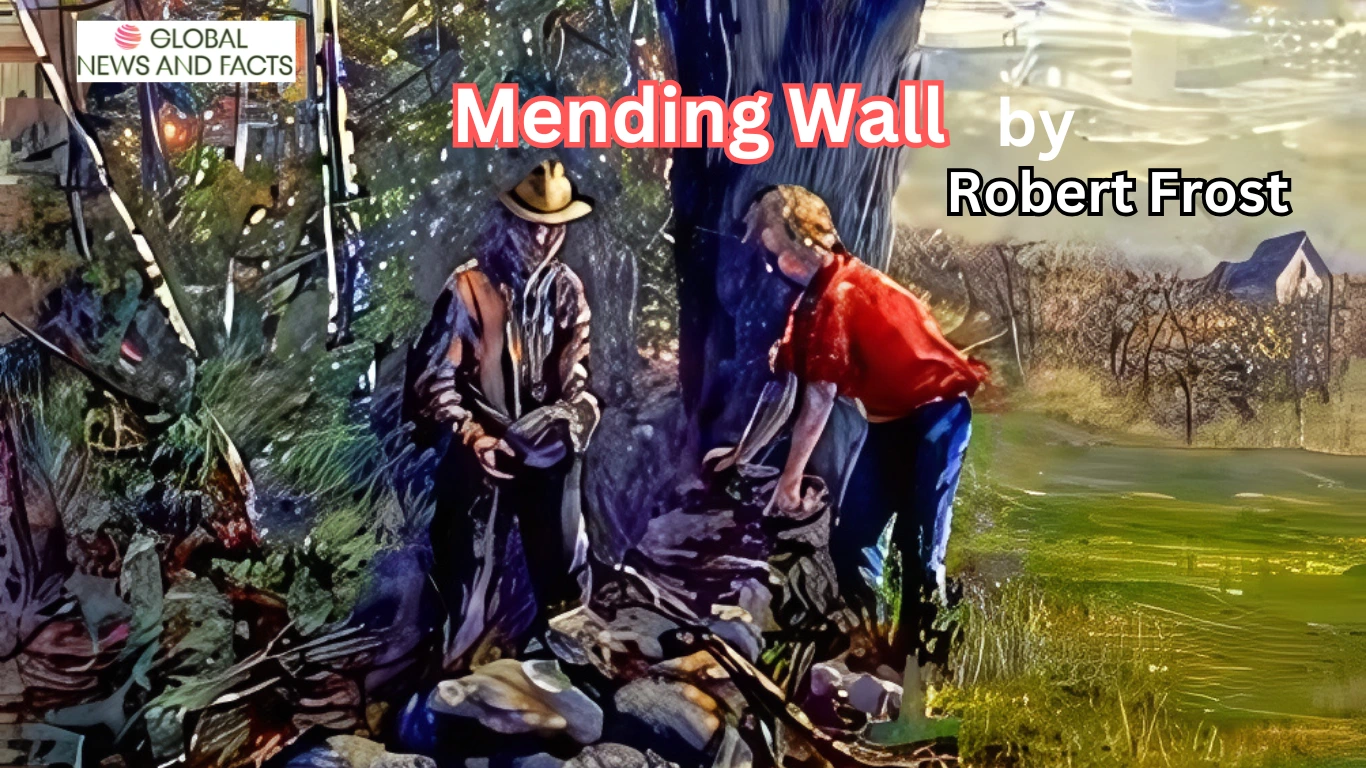
In this poem “Mending Wall by Robert Frost” the speaker talks about how people build walls between themselves, both literally and figuratively. This is because they believe that building fences between neighbours would help to maintain good relations.
Robert Frost
robert frost was an American poet well known for his depiction of rural life in New England in the early twentieth century. Some of his notable poems are “After Apple Picking”, “Acquainted with the Night”, “Stopping by Woods on a Snowy Evening” and “Mending Wall”. He received four Pulitzer prizes for his poetry.
Question-Answer
Q1: Which wall is referred to in the poem and where is it? Identify a line in the poem which is repeated several times and tells us that the narrator doesn’t like a wall?
Ans1: In the poem Mending Wall written by Robert Frost there is a stone wall between the poet and his neighbor that separates their properties. There is a line repeated several times in the poem that shows that the poet does not want there to be a wall between them.
Q2: When do the neighbours repair the wall ? Why does the wall need to be repaired every year?
Ans2: To maintain boundaries between properties and preserve traditional lifestyles. In Robert Frost’s poem “Mending Wall,” neighbours repair a wall every spring. Winter snow causes the frozen ground beneath the wall to swell and the stones in the wall to break down. Rabbits and other animals hide in the cracks and then hunters damage the wall to drive them out. For these reasons, the wall needs to be repaired.
Q3: Why does the neighbour feel that mending the wall is important?
Ans3: The neighbour feels it is important to repair the wall because he believes in traditional customs and believes that “good fences make good neighbours.” He sees the wall as a necessary boundary that helps him maintain a good relationship with his neighbour.
Q4: Describe the relationship between the speaker and the neighbour affected by the wall.
Ans4: The speaker and his neighbour have a civil but somewhat strained relationship because of the wall. They meet annually in the spring to repair a stone wall between their properties. The neighbour, a traditionalist, believes in “good fences make good neighbour.” The speaker disagrees. He questions this; the speaker sees no practical need for the wall. Despite their differences, they maintain a polite and functional relationship. They share a cordial and neighbourly relationship.
Q5: What saying does the neighbour keep repeating? Who had he heard it from and what does it mean to him?
Ans5: In the poem “Mending Walls,” the poet’s neighbour keeps repeating the saying, “Good fences make good neighbours.” He heard this saying from his father, and he sticks by his father’s words and believes that it is a wise and true statement. He believes that there should be clear boundaries between people’s properties because it helps in maintaining good relations between neighbours.
Reference to context
1)
The gaps I mean,
No one has seen them made or heard them made,
But at spring mending-time we find them there.
a) Which "gaps" is the speaker talking about?
Ans: The speaker in the poem "Mending Wall" is talking about the "gaps" or spaces created by nature in the stone wall that has mysteriously formed between his property and neighbour's property. The speaker describes these as being created by invisible forces. That is why, once a year in the spring, the speaker and his neighbour meet to mend it.
b) Who is referred to as "we" in these lines?
Ans: In the poem "Mending Wall", the "we" in these lines means the speaker and his neighbour. They come here together every spring to mend the wall.
c) what is the speaker's opinion about the "gaps"?
Ans: In the poem "Mending Wall", the speaker does not agree at all with his neighbour's words about the gap in the stone wall. The speaker believes that there is some power in nature that does not like the wall. The speaker also says that there is no need for a wall here, which is contrary to his neighbour's opinion.
2)
Oh, just another kind of out-door game,
One on a side. It comes to little more:
There where it is we do not need the wall:
He is all pines and I am apple orchard.
a) What is the "out-door game" that the speaker is talking about?
Ans: The "out-door game" the speaker is talking about in these lines of the poem "Mending Wall" is that every year in the spring the speaker and his neighbours come together to mend the stone wall. The speaker believes that this is like a pointless out-door game in which they are both on their own sides.
b)  Explain the line "Three where it is we do not need the wall" in your own words.
Ans: The above lines are taken from the poem "Mending Wall", the line "There where it is we need no wall" means that where the speaker's apple orchard and the neighbor's pine trees are, there is no practical need for a wall. Neither do they have any animals that can cross the wall and cause damage. The two properties are clearly separate. The speaker feels that there is no need for a wall between their properties.
c) Explain the reference to "pine" and "apple orchard" in the last line of this extract.
Ans: These lines are taken from Robert Frost's poem "Mending Wall". The reference to "pines" and "apple orchard" in the last line shows a mutually obvious difference between the speaker and his neighbour. The pine trees represent the neighbour's more traditional and conservative and firm attitude, which is a contrast to change. On the other hand, the apple orchard represents the speaker's more open-minded and progressive attitude. These contrasting images highlight the fundamental difference between people's attitudes.
3)
I see him there
Bringing a stone grasped firmly by the top
In each hand, like an old-stone savage armed.
He moves in darkness as it seems to me,
Not of woods only and the shade of trees.
a) Who is referred to as "he" in these lines?
Ans: Above lines has been taken from Robert Frost poem "Mending Wall" . In these lines "He" referred to speakers neighbour.
b) What does the speaker mean when he says an "old-stone savage"?
Ans: In the above lines speaker calls his neighbour an "old stone savage". Here the poet is using a metaphor to express the feeling of his neighbour's archaic and primitive mindset. The speaker's neighbour clings to his old traditions and beliefs. As a "savage" armed with stones, the speaker's neighbour suffers from the mindset of building and maintaining a wall. The speaker questions the need for building a wall.
c) Why does the speaker feel that "he" is moving in "darkness"?
Ans: In these lines of the poem "Mending Wall", the speaker feels that his neighbour is "stepping forward into the darkness" because he believes that the neighbour is blindly following old traditions and customs. His neighbour's insistence on maintaining the wall indicates narrow-mindedness and resistance to change.
d) Identify the figure of speech used in these lines and explain it in your own words.
Ans: In the above lines of "Mending Wall" the poet has used the figure of speech "He walks in the dark as I feel" which is a metaphor.
A metaphor is a figure of speech that compares two or more dissimilar things usually without using "like" or "as". The speaker is comparing his neighbour's mindset to darkness. His neighbour is unable to see the world from a different perspective. The darkness symbolizes the neighbour's closed mindset.
Must Read : Python Examples

8833betcasino has been treating me well lately, you might wanna see for yourself. They’ve got all the games you could want, and I’ve had some decent wins. Have a try at 8833betcasino.